
Protein Structural Characterization
Is your protein doing something a static structure won’t show you?
Conformational dynamics, stability, and structural comparability, measured by how different regions exchange hydrogen for deuterium over time.
A crystal structure is one snapshot. Proteins in solution aren’t static, and a lot of the interesting biology shows up as a change in exchange behavior rather than a change in fixed coordinates: a domain that opens up on activation, a region that gets less flexible after a stabilizing mutation, a batch that’s subtly different from the reference lot.
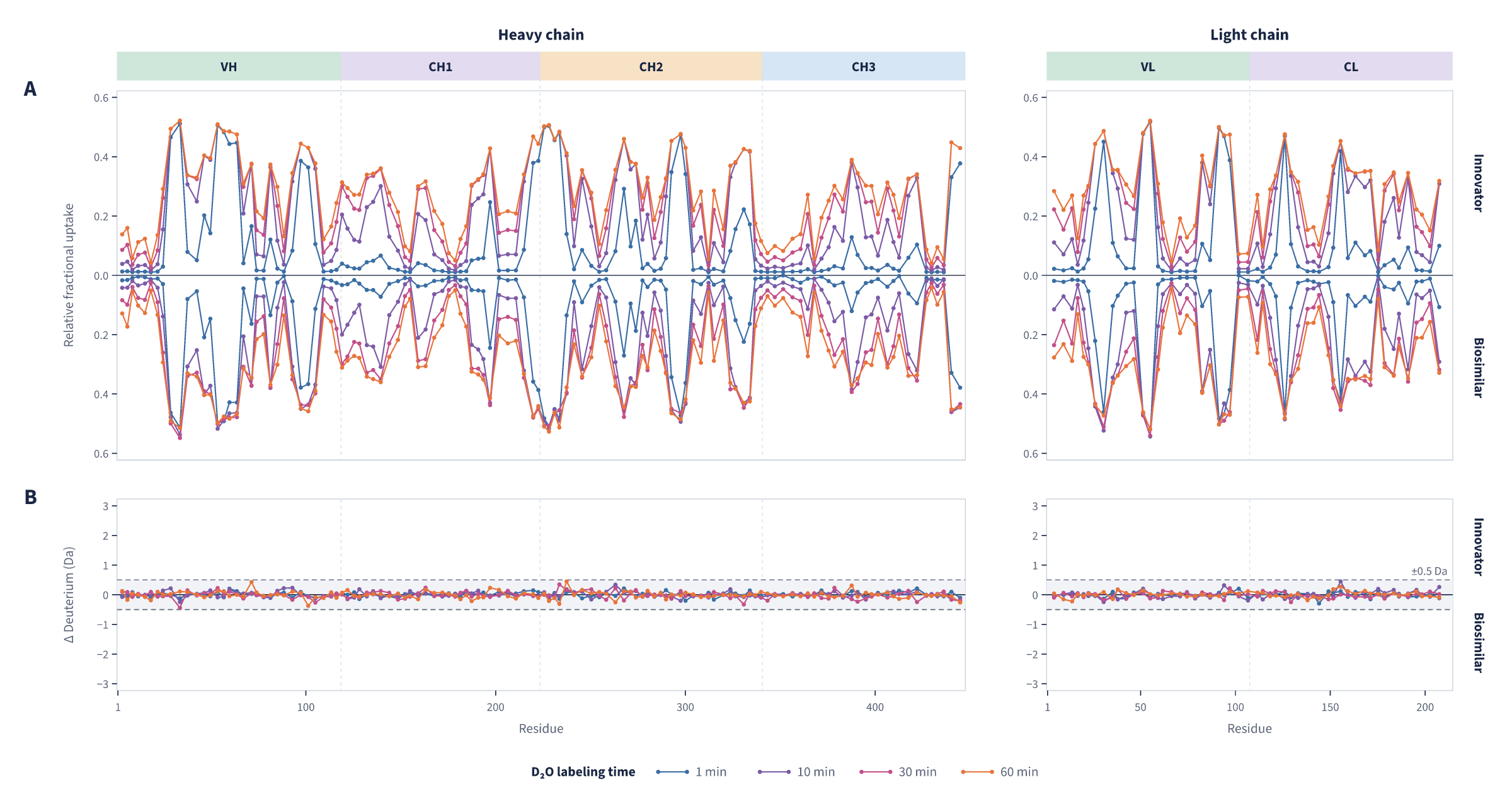
This is the service that gets used most often for comparability. Two preps, two constructs, two formulations, pre- and post-stress: anything where the question is “are these actually the same?” rather than “what does this look like?”
Common reasons clients come to us
- Comparability between a reference product and a new process or site
- Confirming that a stabilizing mutation actually stabilizes the region you intended
- Investigating why a batch behaves differently in a functional assay despite passing standard QC
- Biosimilar higher-order structure comparison
- Mapping which domain moves when a protein is activated or inhibited
Sample Requirements
As a starting point, plan on roughly 200 µg of protein per state. The real amount depends on the protein size and how many conditions you want to compare, so we’ll confirm quantities with you before anything ships.
Other services
Antibody Characterization
Understand how therapeutic antibodies recognize and interact with their targets. Map epitopes and paratopes, investigate mechanisms of action, and support antibody discovery and engineering.
Explore ServiceProtein-Ligand Interaction Analysis
Characterize biomolecular interactions to reveal binding interfaces and molecular recognition. Investigate protein-protein and protein-ligand interactions to support target validation and drug discovery.
Explore Service